
Pontiac’s most famous nameplate spent its final factory year bolted onto a compact economy car most enthusiasts wrote off as a pretender. This surviving 1974 Ventura GTO still wears the shaker hood and Rally wheels that made the badge official — with one telling upgrade under the hood. Here’s how a car built to save face turned into a genuine bargain for the 7,058 people who bought one.
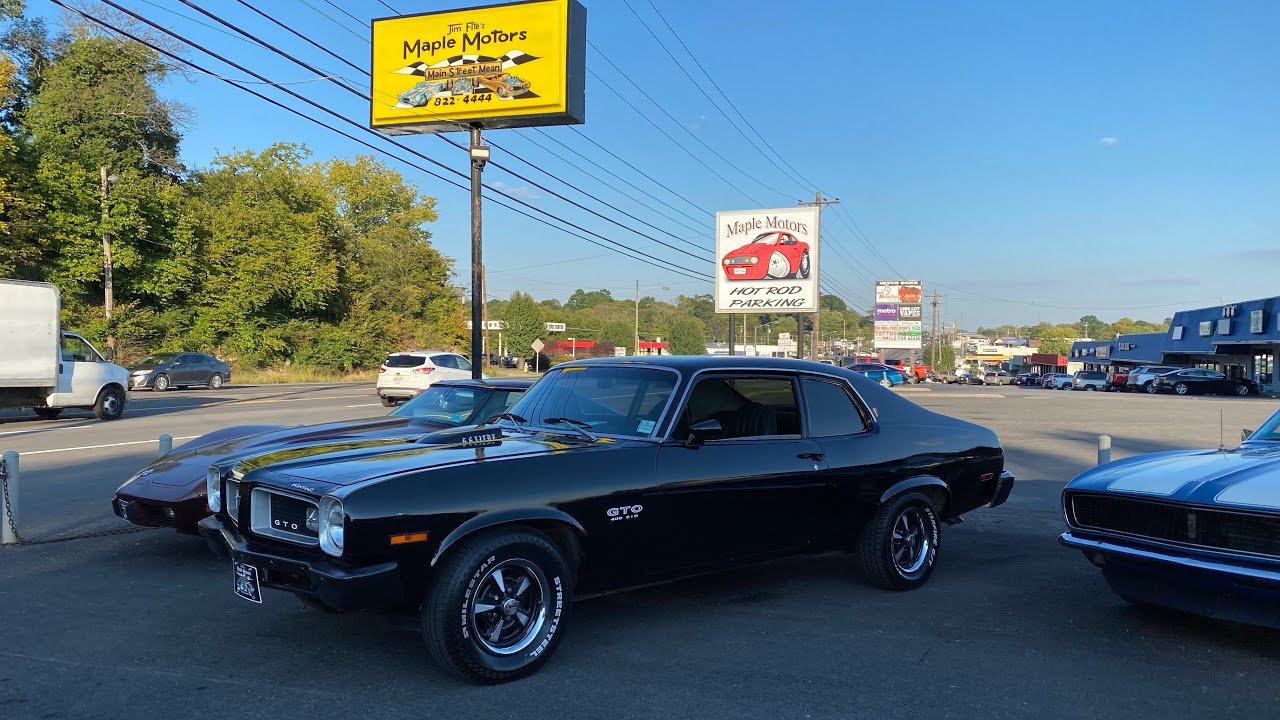
Pontiac’s GTO wasn’t supposed to survive 1973. The A-body original had just posted its worst sales year ever, barely 5,800 cars, and every signal pointed toward pulling the plug for good: the OPEC oil embargo, insurance surcharges that scared off young buyers, and emissions rules that were strangling horsepower across Detroit. One engineer refused to let that happen. His fix wasn’t a bigger engine or a flashier stripe kit — it was moving the GTO name onto Pontiac’s compact Ventura, a car built on the same bones as a Chevy Nova. Purists howled that a “gussied-up economy car” had no business wearing the Goat’s badge. Pontiac sold 7,058 of them anyway, and the survivor in this walkaround — a shaker-hooded, dual-exhaust 1974 out of a Tennessee used-car lot — is proof the compact GTO ran harder than its reputation suggests.
A Diehard Engineer’s Last-Ditch Plan to Save a Dying Nameplate
The video comes from Maple Motors, the Hendersonville, Tennessee dealership whose YouTube channel has built a following filming honest, unscripted walkarounds of the classics that roll across its lot. This one covers stock #1286: a 1974 Pontiac Ventura GTO finished in its era-correct colors, riding on 14-inch PMD Rally wheels, wearing the functional through-the-hood shaker scoop that was the GTO package’s signature piece. Under the hood sits a 400-cubic-inch V8 backed by an automatic transmission, dressed up with Edelbrock accessories, an aluminum radiator, and dual exhaust routed through Flowmaster-style mufflers. Power steering, power front discs, front and rear sway bars, bucket seats, a floor shifter, and an aftermarket tach-and-gauge cluster round out the build. It was listed at $19,900. Maple Motors runs one of the more consistent classic-car walkaround channels on YouTube for exactly this reason — the cars are unrestored survivors and honest drivers pulled straight off a working dealership lot, not concours trailer queens, so the wear, the swaps, and the decades of ownership history tend to show rather than get polished away.
That 400-cube engine is worth pausing on, because it’s not something Pontiac ever bolted into a genuine ’74 GTO from the factory — more on that below. What the video does capture well is the car’s presence: a compact coupe that, at a glance, reads far closer to a mid-’60s muscle car than a Nixon-era economy special. The comment section backs that up with decades of firsthand memories. One commenter called it “a Nova and a Firebird” that “had one night stand.” Another wrote that their friend’s copper-colored ’74 and their own black Trans Am earned them the nickname “the Pontiac brothers” growing up. A third remembered a 4-speed, California-built GTO convert they owned outright, while several others recalled family Venturas — GTO package or not — that their parents drove home new. One person summed up the car’s identity crisis about as well as anyone could: “you get the best of both worlds, you get a GTO-Nova.” Another put it more simply — they just called it “this Nova cousin,” overlooked but sexy, in their words, and long overdue for some respect.
As an Amazon Associate I earn from qualifying purchases.
One Engine, One Option Package, and a Nameplate on Life Support
To understand why a Nova-based Pontiac carries the GTO name at all, you have to start with how bad 1973 was. The GTO had spent a decade as the car that arguably invented the muscle car category in 1964, but by its final year on the mid-size A-body platform it had fallen to just 5,800 sales — a number that gave Pontiac’s leadership every reason to kill the nameplate outright. Engineer Ben Harrison, a GTO loyalist inside the company, pitched an alternative: strip the GTO down to an options package and graft it onto the Ventura, Pontiac’s version of the compact X-body platform it shared with the Chevrolet Nova. Management approved it, and the GTO got a one-year reprieve for 1974.
The package, officially option code WW3, added $415 to $461 to a Ventura that started around $3,000, and it came with exactly one engine choice: a Pontiac-built 350-cubic-inch V8 with a four-barrel Quadrajet carburetor, rated at 200 horsepower at 4,400 rpm and 295 lb-ft of torque at 2,880 rpm. That was down considerably from the big-block GTOs of the late 1960s, but the X-body shell was roughly 400 pounds lighter than the outgoing A-body car, which helped close the gap. A three-speed manual with a floor shifter was standard, with a Saginaw four-speed and a Turbo-Hydramatic 350 automatic available as roughly $200 options. Standard Rally II wheels, a full multicolor stripe-and-badge graphics package, and that functional shaker hood scoop — nearly identical in appearance to the Firebird Trans Am’s — came bundled in. Buyers could choose a two-door post coupe or a three-door hatchback; about three-quarters went with the coupe. Beyond the package itself, the order sheet read like any other economy car’s: bucket seats added $67, a center console with gauges ran another $41 and $37 respectively, front disc brakes were a $71 option, and variable-ratio power steering cost $100 — the kind of line-item pricing that made the GTO feel less like a factory hot rod and more like a well-optioned commuter that happened to come with a shaker hood.
The skepticism aimed at the car wasn’t unreasonable on paper, but the numbers held up better than expected. Cars magazine ran a head-to-head quarter-mile comparison between an original ’64 GTO and the ’74 X-body car with East Coast Pontiac tuner Nunzi Romano behind the wheel, and the two clocked remarkably similar mid-15-second times near 90 mph. Pontiac ultimately built 7,058 of the compact GTOs for 1974 — split roughly between 5,335 coupes and 1,723 hatchbacks across manual and automatic combinations — comfortably outperforming 1973’s dismal total. There was even talk internally of continuing the package into 1975, including a proposed Hurst-tuned special edition. None of it happened. The GTO option quietly disappeared from the Ventura’s order sheet after just one model year, and the name went dormant for three decades until Pontiac revived it in 2004 on a Holden Monaro-based coupe built in Australia.
Why This Survivor Runs a Bigger Engine Than Pontiac Ever Offered
Every factory ’74 GTO left the assembly line with that same 350, full stop — Pontiac never certified a 400 for the Ventura-based GTO package. So a 400-cube V8 under the hood of a car like stock #1286 means one of two things: a later owner performed an engine swap, or the car was built as a plain Ventura and had the GTO’s visual and mechanical upgrades added afterward. Either way, it’s not a knock on the car. The comment section is full of owners describing the same thing happening to their own ’74s and ’75 Venturas decades ago — more than one mentions running a 400 where a 350 once sat, and it’s clearly a well-worn path for a platform that plenty of enthusiasts felt was underpowered from the factory.
What makes this particular example worth a second look isn’t factory correctness; it’s that someone cared enough about a car the muscle car establishment dismissed in period to keep it dressed exactly as Pontiac intended, shaker hood and all, while quietly fixing the one thing everybody complained about in 1974. Fifty-plus years later, that combination of period-correct looks and a little extra muscle is exactly why the “gussied-up Nova” argument still gets an argument back from the people who actually owned one.
It’s also a useful reminder of how differently the 1974 GTO reads once you separate the car from the reputation. Every complaint leveled at it in period — too small, too light, sharing a windshield with a grocery-getter — is the exact same formula that, decades later, would define an entire generation of celebrated compact performance cars. Pontiac wasn’t cheapening the GTO nameplate so much as it was accidentally building a preview of where performance cars were headed once the big-block era ended for good. That context is easy to miss watching a single $19,900 dealer listing, but it’s a large part of why survivors like this one keep showing up in driveways and comment sections full of people who owned one the first time around.
Watch the full video above and let us know your thoughts in the comments.
Related posts:
 The 1969 Pontiac GTO Judge Was Born From a TV Punchline — And Almost Nobody Got the Fastest Version
 Pontiac Almost Paid $250,000 for a TV Joke to Name the 1969 GTO Judge
 Oldsmobile Had No Budget, No Bigger Engine, and Only Months to Answer the GTO — The 1965 4-4-2 Beat It Anyway
 This 1969 Mustang Mach 1 Slept in a Barn for 20 Years — Then the Restoration Took a Turn Nobody Expected
 Everyone Remembers the Chevelle SS 454 — Almost Nobody Remembers the Olds 442 W-30 That Could Beat It
 The 1970½ Camaro Z/28’s Small-Block Almost Beat Chevy’s Own Big Block — Here’s How a 360-HP LT-1 Did It
 A Bone-Stock 1969 GTO Just Got the Judge Treatment It Never Had — And the LS Swap Is Only Half the Story
 Five Muscle Car Engines That Still Sound Better Than Anything Detroit Builds Today
 Why This Connecticut Owner’s “Ordinary” 1969 Oldsmobile 442 Might Be the Smarter Muscle Car Buy
 AMC Only Needed 2,500 of These to Go Racing – They Built One More Just to Prove It: The 1970 Javelin Mark Donohue Edition, Explained


